Count Basie
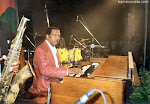
Count Basie was born as William James Basie on August 21, 1904, in Red Bank, New Jersey. He became a legendary American jazz pianist, organist, bandleader, and composer. In 1935, he formed the Count Basie Orchestra, and in 1936 took them to Chicago for a long engagement and their first recording. He led the group for almost 50 years, creating innovations like the use of two "split" tenor saxophones, emphasizing the rhythm section, riffing with a big band, using arrangers to broaden their sound, his minimalist piano style, and others.
William Basie was born at 229 Mechanic Street on August 21, 1904. His father, Harvey Lee Basie, was a coachman and caretaker; his mother, Lillian Childs Basie, was a laundress, taking in washing and ironing. A brother, James, died when William was a young boy. The family always owned a piano, and Lilly Ann paid twenty-five cents per lesson to teach William to play. In addition to helping his parents, William also did chores at Red Bank’s now-defunct Palace Theater. A projectionist taught him to rewind the reels, switch between projectors, and operate the spotlight for the vaudeville shows. On the afternoon the Palace’s house pianist failed to show for work, Basie offered to fill in – but was denied. Nonetheless persistent, the young Basie waited for the film to start, crept into the orchestra pit, and accompanied the film anyway. He was invited back to perform that evening.

Though Basie’s initial intentions were to become a drummer, his ambitions in that direction were forever erased after hearing drummer Sonny Greer from Long Branch. Greer, who later rose to fame as the drummer for the Duke Ellington Orchestra, was so obviously superior to Basie that he made a hasty retreat to the piano. The men became friends and formed a duo.
Decades later, the two would be among fifty-seven musicians photographed on the stoop of a Harlem, brownstone by Art Kane, in a shot to accompany an Esquire magazine article on the “Golden Age of Jazz.” The photograph would later become as famous as the subjects it depicted, as inspiration for the documentary A Great Day in Harlem.
Before he was 20 years old, he toured extensively on the Keith and TOBA vaudeville circuits as a solo pianist, accompanist, and music director for blues singers, dancers, and comedians. This provided an early training that was to prove significant in his later career.
In 1924, Basie moved to New York City. There, he met and was influenced by noted stride pianists James P. Johnson and Fats Waller. Though just a teenager, Basie was touring as a pianist and accompanist on the major vaudeville circuits. It’s believed that his experience in these roles ultimately lead to Basie’s reputation as a bandleader who had no issues with younger musicians taking up the spotlight.
In 1927, a canceled tour left Basie stranded in Kansas City, Missouri. He remained there, eventually joining bassist Walter Page’s Blue Devils, an outfit that also included vocalist Jimmy Rushing and trumpeter Oran “Hot Lips” Page. Each would one day figure prominently in Basie’s own band.
Basie left the Blue Devils early in 1929 to play with other bands in the area, and later that year schemed his way into the top band in the territory, the Bennie Moten band.
Like many bandleaders of the day, Moten ran what was called a “commonwealth band,” with each member of the band having a say in the band’s operations. During one dispute about an upcoming performance, the band voted to oust Moten as its leader and – though he was not one of the instigators – installed Basie as its new leader.

The new band billed itself as Count Basie and his Cherry Blossom Orchestra, marking the first time that “Count” was officially added to his name. Though stories abound at the genesis of his nickname, Basie later recalled it as a tribute to his penchant for slipping off during arranging sessions with Moten. As soon as they got a few good bars down, Basie recalled, he’d slip out, leaving Moten to exclaim, “Where is that no ‘count rascal?”
Though Basie embraced his opportunity to lead a band, he quickly jumped ship to work with Moten’s new band, where he remained until Moten’s unexpected death in 1935. Soon, Basie and saxophonist Buster Smith pieced together their own nine-piece outfit, comprised of former members of the Blue Devils and the Bennie Moten Band. This new collective, Count Basie and His Barons of Rhythm, secured a residency at the Reno Club in Kansas City – a stay historians regard as Basie’s biggest career turning point.
Many musicians came to prominence under his direction, including the tenor saxophonists Lester Young and Herschel Evans, the guitarist Freddie Green, trumpeters Buck Clayton and Harry "Sweets" Edison, plunger trombonist Al Grey, and singers Jimmy Rushing, Helen Humes, Dennis Rowland, Thelma Carpenter, and Joe Williams.

Basie and his Orchestra appeared in five films, all released within a matter of months in 1943: Hit Parade, Reveille with Beverly, Stage Door Canteen, Top Man, and Crazy House. He also scored a series of Top Ten hits on the pop and R&B charts, including I Didn’t Know About You, Red Bank Blues, Rusty Dusty Blues, Jimmy’s Blues, and Blue Skies.
In 1950, financial restraints forced Basie to disband the orchestra. For the next two years, he led small bands between six and nine pieces. Basie reorganized the Orchestra in 1952, and this new band was in high demand and toured extensively around the world. (This became known as the “New Testament Band”, while the first Orchestra was the “Old Testament Band.”) They played command performances for kings, queens, and presidents, and issued a large number of recordings both under Basie’s name and as the backing band for various singers, most notably Frank Sinatra.
Some argue Basie made some of his best work during the 1960s and ’70s: Shiny Stocking, L’il Darlin, Corner Pocket, and even a hit single, Everyday I Have the Blues, with Joe Williams. During this period, he also recorded with music greats, Ella Fitzgerald, Frank Sinatra, Sammy Davis Jr., Jackie Wilson, Dizzy Gillespie, and Oscar Peterson.
Basie was a true innovator, leading the band for almost 50 years and recording on over 480 albums. He is credited for creating the use of the two “split” tenor saxophones, emphasizing the rhythm section, riffing with a big band, using arrangers to broaden their sound, and beautifully layering masterful vocalists. Basie was often recognized for his understated yet captivating style of piano playing and his precise, impeccable musical leadership.
Basie earned nine Grammy Awards and made history in 1958 by becoming the first African-American to receive the award. He has had an unprecedented four recordings inducted into the Grammy Hall of Fame – One O’Clock Jump (1979), April in Paris (1985), Everyday I Have the Blues (1992), and Lester Leaps In (2005), along with a slew of other awards and honors not only for his music, but for his humanitarianism and philanthropy around the world.
The Music of Count Basie playlist
https://njjs.org/celebrating-count-basie-in-his-hometown-2/
https://syncopatedtimes.com/count-basie/
https://countbasie.rutgers.edu/biography/
https://thebasie.org/countbasiebio/
https://en.wikipedia.org/wiki/Count_Basie


 Posts
Posts