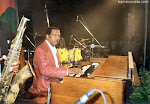
An independent Billboard-ranked musician and NAACP Image Award-nominated jazz keyboardist and pianist, Marcus Johnson is also the CEO and Founder of FLO Brands, LLC and more recently FLO Wine, LLC. He has combined an eminently successful musical career with his love of wine by marrying the two in a unique endeavor. Marcus Johnson - Chillin' at The FLO'cial
Marcus Johnson was born in Columbus, Ohio. He and his family moved to Washington, D.C. when he was 12 years old. He grew up listening to a wide variety of music but found his calling in jazz, where he incorporates the rhythms of rap with R&B. His interest in jazz first showed itself when he began “tinkling the keys at age 13 (his step-father won Maryland's "Pick-3 Lottery" and used the winnings to buy Johnson's first keyboard) and he found himself studying both traditional and contemporary jazz musicians (Joe Sample and Thelonious Monk are two names he frequently cites)”.
At age ten, he established a neighborhood lawn care service. As a teenager, he started an auto-detailing company. He "played in a jazz band at Montgomery Blair High School". Although he attended University of Miami at one point (learning about music production), Johnson earned a bachelor of arts degree in music at Howard University, where he was a member of Alpha Phi Alpha fraternity. Afterwards, at Georgetown University, he earned both an MBA and law degree.
Over the last decade, Marcus Johnson has released 15 successful studio albums. On Pandora, Marcus receives 5.1 million spins per year with 2,000 new stations added each month, and his music receives a 74% “thumbs ups” rating verses an average of 56%. Johnson is the owner of a music label, Three Keys Music, and has emerged as one of the young lions of the “DIY” music world. His unique self-taught style of piano play has earned him distinction among his peers, praise from the media and accolades across the music industry. Marcus is on the cutting edge of ‘Euro Jazz’ having formed JURIS, a musical collaboration with acclaimed Parisian DJ and producer Young Pulse. The duo quickly developed a name within the international music community, enjoying large-scale performances and preparing a Q3 release of their latest project entitled “Eiffel Tower.”
Johnson’s FLO Brands, LLC,tm is aptly titled For the Love Of ; LLC. ™ FLO began as a musical publishing, production, and lifestyle branding company to house all of Johnson’s musical and entrepreneurial ventures. However the scope and reach of the company has expanded delving into winemaking, sourcing grapes and production in California. FLO Brands launched FLO Wines, LLC in March 2012. FLO Wine is capturing the taste buds of wine-lovers from California to South Carolina.
As the owner and brand ambassador, a marketing initiative is currently underway with Johnson’s “Sips & Sounds” performances marrying music and wine For the Love Of concept. FLO Wine currently offers a FLO Red Californian Blend and a FLO California Chardonnay. As of July 2013 the company is launching its 2011 FLO California Moscato.
A graduate of Howard University, Johnson went on to simultaneously earn both his MBA and Juris Doctorate degrees at Georgetown University. In 1995 during this demanding period at Georgetown, he also decided to independently produce and distribute his first jazz album, Lessons in Love, which sold more than 40,000 units, a major success for an unknown independent artist’s debut release. One year later, he released Inter Alia, with great acclaim. These two albums led to Johnson signing with N2K Encoded Music with whom he released several CDs until the label was sold in 1998.
Johnson’s success caught the attention of Black Entertainment Television (BET) founder and businessman Robert L. Johnson who invested in Marcus and his newfound company, Marimelj Entertainment Group (MEG). Under their partnership, MEG’s label, Three Keys Music based in the Washington, DC metro area, established its own full service recording studio, Studio 8121; and two music publishing companies, Marimelj Music Publishing and Three Keys Music Publishing. Marcus was responsible for releasing and producing CDs on the Three Keys label for national jazz artists Michael Lington, Jaared Arosemena, Bobby Lyle, Nick Colionne, R&B singer, Alyson Williams and neo-soul songstress Yahzarah and smooth jazz Saxophonists Phillip Martin and Brian Lenair.
While producing music for the aforementioned artists, Marcus also released several critically acclaimed albums: Inter Alia, Chocolate City Groovin’; Coming Back Around; Urban Groove, In Person: Live at Blues Alley, Just Doing What I Do, Smooth Jazz Christmas and In Concert for a Cause, all charting at Top 20 or more on Billboard’s Contemporary Jazz Charts.
Marcus has released 15 Billboard-charted CDs. He has the distinction of having his groundbreaking 2008 Billboard Top 20 Contemporary Jazz FLO (For the Love Of) CDs which consisted of three distinct albums:¬ FLO Chill, FLO Romance and FLO Standards , all charting Top 10 on Billboard Contemporary Jazz Charts simultaneously. Johnson’s previous solo 2007 release, The Phoenix, was widely lauded by jazz critics and aficionados alike and like Johnson’s previous CDs, it peaked in the Top 20 of Billboard’s Contemporary Jazz charts.
Johnson’s next Top 20 Contemporary jazz releases, the unique and multi-faceted Poetically Justified (2009) and This Is How I Rock (2011) solidified Marcus Johnson as heir apparent to the George Duke and Herbie Hancock style of funky urban groove music. Creatively, Johnson continues to evolve as an artist. With the release of his 2012 FLO: Holiday CD and the ongoing collaboration with famed Parisian Producer DJ Pulse – as the musical duo “JURIS” – he has managed to maintain his traditional jazz roots, while also remaining on the forefront of the expanding “Euro Jazz” movement. His music continues to enforce and define his musical legacy as a “jazz movement for all people”.
Johnson is also evolving as an innovative wine expert. He resides in the Metropolitan Washington area and is a new father. His daughter Chase was born on September 12, 2012. Marcus is currently featured weekly on Fox News and is involved with community and charity events, including service on the Board of the Boys and Girls Club. His dynamic career also includes teaching. He served on the faculty of Georgetown University Center For Professional Development in 2007, and taught at Bowie State University from 2008 through 2010, adjunct business development.
Kirk Whalum is the recipient of numerous awards and acknowledgements for musical excellence. An eleven-time Grammy nominee, he won his first Grammy award for Best Gospel Song (“It’s What I Do” featuring Lalah Hathaway) alongside life-long friend and writer Jerry Peters. He has won two Stellar Awards and received three Dove Award nominations and an NAACP Image Award nomination. The Gospel According to Jazz,Selections Playlist
Forged from his gospel roots in Memphis, Tenn., the special soulful,passionate sound of Kirk Whalum moves the inner soul of the lisener. The rich tenor sax sound is unmistakably his.
Kirk Whalum (born July 11, 1958) was born in Memphis, Tennessee. He attended Melrose High School and Texas Southern University where he was a member of the World Famous Ocean of Soul Marching Band. In addition to singing in his father's church choir, Whalum learned to love music from his grandmother, Thelma Twigg Whalum, a piano teacher, and two uncles, Wendell Whalum and Hugh "Peanuts" Whalum, who performed with jazz bands around the country. "The music I like to play and write encompasses the four elements I grew up with: Memphis R&B, gospel, rock, and jazz. The emphasis, though, is on melody.
An ordained minister, Kirk earned his Masters of Art in Religion. He serves his community performing at schools, missions, special programs and nursing homes. In addition to music ministry he has a special passion to educate young aspiring musicians. Kirk Whalum is the President/CEO of the STAX Music Academy and the STAX Museum of American Soul Music In Memphis, Tenn.
From his early days in Memphis where he played in his father's church choir, veteran saxophonist Kirk Whalum drew inspiration from the rich musical traditions of that city, including gospel, R&B, blues, and eventually jazz. He received a scholarship to attend music school at Texas Southern University, where he formed a band in 1979 and began playing shows on the local club circuit.
When he opened for Bob James in Houston in 1984, the pianist was impressed with Whalum's expressive style, and invited him to play on his album 12. Whalum soon signed with Columbia Records and released his first solo album, Floppy Disk, in 1985. That album (as well as the next two, 1988's And You Know That! and 1989's The Promise) was produced by James, continuing the musicians' fruitful partnership. The early '90s saw Whalum issuing two more albums on the Columbia label -- Caché in 1993 and In This Life in 1995 -- each of them earning the saxophonist increased commercial attention and critical praise. Later, a duet with James titled "Joined at the Hip" took Whalum's career to a new level, as the song garnered Whalum his first Grammy nomination.
For nearly six decades, Miles Davis has embodied all that is cool – in his music (and most especially jazz), in his art, fashion, romance, and in his international, if not intergalactic, presence that looms strong as ever today. 2006 – The year in which Miles Davis was inducted into the Rock And Roll Hall Of Fame on March 13th – is a landmark year, commemorating the 80th anniversary of his birth on May 26, 1926, and the 15th anniversary of his death on September 28, 1991. In between those two markers is more than a half-century of brilliance – often exasperating, brutally honest with himself and to others, uncompromising in a way that transcended mere intuition. Miles Davis The Miles Davis Story
Miles Davis: Walkin'
There's an eternal battle nearly every underground artist fights. In theory, achieving mainstream cultural acceptance and ubiquity for the art you create without having to change a note of it should be a major victory. But the taste is often bittersweet. You can't help but wonder what you've lost in becoming successful. Think of that little emocore trio from Seattle who's second album went on to become one of the most significant albums (and best selling) of all time despite being every bit as abrasive and-let's say-grungy as their first. But no originally revolutionary musical movement has gone so completely from the home of rebels to the toast of high society as the “Great American Art Form” known as jazz.
Jazz was originally the respite of absurdly talented musicians not welcomed by the white establishment in traditional orchestras. By the mid-60's the variant of jazz which emphasized small combos and long solos known as bebop wasn't just accepted by the establishment. It was the establishment. Codified in the “Real Book” and the “Fake Book;” two enormous volumes of simplified sheet music for the entire collection of traditionally accepted jazz standards. What in classical music and traditional theatre they call “the Canon.”
I often wonder what the heroin addicted rebel genius Charlie Parker would have thought had he lived long enough to see doctorate programs in jazz composition and performance and major universities, with his own music held up as the golden ideal. Though Parker may have lived fast and died young, one of his frequent collaborators, and another of the great innovators of bebop, Miles Davis survived to see his cultural victory was a Pyrrhic one. Witnessing the utter co-option of his art form at the hands of the mainstream Davis drew a line in the sand in 1970 when he released the landmark Bitches Brew.
He had been moving away from bop at that point for a decade at least, but his previous recordings (even the heavily electric In A Silent Way from 1969) still maintained a tenuous connection to the past. In A Silent Way, despite it's electric and free jazz leanings even borrowed the Sonata Form from classical music. Bitches Brew was a complete break from all this. It was an ugly, confrontational, emotionally brutal, noisy mess of an album.
Miles Dewey Davis III (May 26, 1926 – September 28, 1991) was an American jazz musician, trumpeter, bandleader, and composer. Widely considered one of the most influential musicians of the 20th century, Miles Davis was, with his musical groups, at the forefront of several major developments in jazz music, including bebop, cool jazz, hard bop, modal jazz, and jazz fusion.
On October 7, 2008, his 1959 album Kind of Blue received its fourth platinum certification from the Recording Industry Association of America (RIAA), for shipments of at least four million copies in the United States. Miles Davis was inducted into the Rock and Roll Hall of Fame in 2006.
Davis was noted as "one of the key figures in the history of jazz". On December 15, 2009, the U.S. House of Representatives passed a symbolic resolution recognizing and commemorating the album Kind of Blue on its 50th anniversary, "honoring the masterpiece and reaffirming jazz as a national treasure.
Miles Dewey Davis was born on May 26, 1926, to an affluent African American family in Alton, Illinois. His father, Miles Henry Davis, was a dentist. In 1927 the family moved to East St. Louis, Illinois. They also owned a substantial ranch in northern Arkansas, where Davis learned to ride horses as a boy.
Davis' mother, Cleota Mae (Henry) Davis, wanted her son to learn the piano; she was a capable blues pianist but kept this fact hidden from her son. His musical studies began at 13, when his father gave him a trumpet and arranged lessons with local musician Elwood Buchanan. Davis later suggested that his father's instrument choice was made largely to irk his wife, who disliked the trumpet's sound. Against the fashion of the time, Buchanan stressed the importance of playing without vibrato; he was reported to have slapped Davis' knuckles every time he started using heavy vibrato. Davis would carry his clear signature tone throughout his career. He once remarked on its importance to him, saying, "I prefer a round sound with no attitude in it, like a round voice with not too much tremolo and not too much bass. Just right in the middle. If I can’t get that sound I can’t play anything."
In the fall of 1944, following graduation from high school, Davis moved to New York City to study at the Juilliard School of Music.
Upon arriving in New York, he spent most of his first weeks in town trying to get in contact with Charlie Parker, despite being advised against doing so by several people he met during his quest, including saxophonist Coleman Hawkins.
Finally locating his idol, Davis became one of the cadre of musicians who held nightly jam sessions at two of Harlem's nightclubs, Minton's Playhouse and Monroe's. The group included many of the future leaders of the bebop revolution: young players such as Fats Navarro, Freddie Webster, and J. J. Johnson. Established musicians including Thelonious Monk and Kenny Clarke were also regular participants.
Davis dropped out of Juilliard, after asking permission from his father. In his autobiography, Davis criticized the Juilliard classes for centering too much on the classical European and "white" repertoire. However, he also acknowledged that, while greatly improving his trumpet playing technique, Juilliard helped give him a grounding in music theory that would prove valuable in later years.
Davis began playing professionally, performing in several 52nd Street clubs with Coleman Hawkins and Eddie "Lockjaw" Davis. In 1945, he entered a recording studio for the first time, as a member of Herbie Fields's group. This was the first of many recordings to which Davis contributed in this period, mostly as a sideman. He finally got the chance to record as a leader in 1946, with an occasional group called the Miles Davis Sextet plus Earl Coleman and Ann Hathaway—one of the rare occasions when Davis, by then a member of the groundbreaking Charlie Parker Quintet, can be heard accompanying singers. In these early years, recording sessions where Davis was the leader were the exception rather than the rule; his next date as leader would not come until 1947.
Around 1945, Dizzy Gillespie parted ways with Parker, and Davis was hired as Gillespie's replacement in his quintet, which also featured Max Roach on drums, Al Haig (replaced later by Sir Charles Thompson and Duke Jordan) on piano, and Curley Russell (later replaced by Tommy Potter and Leonard Gaskin) on bbass.
Despite all the personal turmoil, the 1950–54 period was actually quite fruitful for Davis artistically. He made quite a number of recordings and had several collaborations with other important musicians. He got to know the music of Chicago pianist Ahmad Jamal, whose elegant approach and use of space influenced him deeply. He also definitively severed his stylistic ties with bebop.
In 1951, Davis met Bob Weinstock, the owner of Prestige Records, and signed a contract with the label. Between 1951 and 1954, he released many records on Prestige, with several different combos. While the personnel of the recordings varied, the lineup often featured Sonny Rollins and Art Blakey. Davis was particularly fond of Rollins and tried several times, in the years that preceded his meeting with John Coltrane, to recruit him for a regular group. He never succeeded, however, mostly because Rollins was prone to make himself unavailable for months at a time. In spite of the casual occasions that generated these recordings, their quality is almost always quite high, and they document the evolution of Davis' style and sound. During this time he began using the Harmon mute, held close to the microphone, in a way that grew to be his signature, and his phrasing, especially in ballads, became spacious, melodic, and relaxed. This sound was to become so characteristic that the use of the Harmon mute by any jazz trumpet player since immediately conjures up Miles Davis. Miles Davis - Flamenco Sketches
From the 'Kind of Blue' sessions, the finest jazz sessions in the history of jazz. Probably the most influential sessions also. All of this is one take and pure improvisation. This is the take that went on the album, there are others. Bill Evan's sense of composition, melody, and modal progression are on full display in this song. He was the one who composed it, then they all made magic in the studio. Miles Davis' crowning achievement was putting these guys and these songs together.
Miles Davis & Gil Evans 1959
In the late 1950s and early 1960s, Davis recorded a series of albums with Gil Evans, often playing flugelhorn as well as trumpet. The first, Miles Ahead (1957), showcased his playing with a jazz big band and a horn section arranged by Evans. Songs included Dave Brubeck's "The Duke," as well as Léo Delibes's "The Maids of Cadiz," the first piece of European classical music Davis had recorded. Another distinctive feature of the album was the orchestral passages that Evans had devised as transitions between the different tracks, which were joined together with the innovative use of editing in the post-production phase, turning each side of the album into a seamless piece of music.
In 1958, Davis and Evans were back in the studio to record Porgy and Bess, an arrangement of pieces from George Gershwin's opera of the same name. The lineup included three members of the sextet: Paul Chambers, Philly Joe Jones, and Julian "Cannonball" Adderley. Davis called the album one of his favorites.
Sketches of Spain (1959–1960) featured songs by contemporary Spanish composer Joaquin Rodrigo and also Manuel de Falla, as well as Gil Evans originals with a Spanish flavor. Miles Davis at Carnegie Hall (1961) includes Rodrigo's Concierto de Aranjuez, along with other compositions recorded in concert with an orchestra under Evans' direction. Gil Evans Miles Davis Sketches of Spain
Sessions with Davis and Evans in 1962 resulted in the album Quiet Nights, a short collection of bossa novas that was released against the wishes of both artists: Evans stated it was only half an album, and blamed the record company; Davis blamed producer Teo Macero, whom he didn't speak to for more than two years. This was the last time Evans and Davis made a full album together; despite the professional separation, however, Davis noted later that "my best friend is Gil Evans."
MILES DAVIS IN HIS OWN WORDS
The Legendary Miles Davis
Miles Davis In 1959 "Kind Of Blue" Miles Davis - Around The Midnight (1967)
Miles Davis - Tutu. Live in Stuttgart 1988. Miles-Davis Montreux 1986
Cassandra Wilson By Nicole Nelson Cassandra Wilson is often described as not only an accomplished jazz vocalist and composer but also as a lyricist, producer, musical director, guitarist and pianist . Born in Jackson, Mississippi, in 1955, Cassandra Wilson has been singing and performing since she sang at her brother’s kindergarten graduation at the age of five. The youngest of three children, Wilson began playing the piano and guitar at the age of nine. Cassandra attributes her interest in music to her parents. Her mother, who is a retired elementary school teacher, and father, who is a bass guitarist, often sang to her as a small child. Her father introduced her to jazz . Jazz was not a very popular form of music during the 1960’s, but Cassandra loved it so much that she wanted to share it with others . Wilson took lessons in classical piano for six years, before learning to play acoustic guitar. She enjoyed experimenting with the guitar, and the instrument soon became her favorite. Between the ages of eleven and fifteen, she wrote about twenty original songs
Cassandra Wilson Feeling It All Playlist
A former classmate, Dr. Phillip Nelson, recalls a time when she shared her newfound love for jazz with the entire student body at a Jackson's Powell Junior High School talent show. “You have to remember that at that time the only thing we listened to was R&B, and she got on stage with a guitar and played a type of music no one had really heard before. It was much like a ballad, and although she didn’t get a lot of attention (there was a lot of talking going on), she didn’t get booed off stage either. I was impressed by the courage she demonstrated to sing an alternative selection. She sang well. She had a great stage presence, and although she didn’t play anything popular, she was good enough to have people stand there and listen to her, and that’s when I realized that she had broader experiences, at least musically than most people at that age. She sang that song because she loved it, and she didn’t care if you liked that song or not, and I respected her for that”.
When Cassandra was in the ninth grade, the schools were desegregated in Mississippi. Her ninth and tenth-grade years were difficult as Cassandra recalls but were better for the remainder of her high school years. Despite the racial tensions that were present in her new school setting, she eventually adjusted to her environment. In the eleventh grade, she got the leading role as Dorothy in The Wizard of Oz. “ For all the negative aspects, experiencing things that were different from what I knew was also exciting,” says Cassandra in an interview for The Oxford American in its 1997 music issue. Obtaining the starring role in the high school musical was not the first time Cassandra stepped over the color lines and made a mark for herself and others. During her last years in high school, Wilson formed a musical group with two young men who were both white. “She had difficulty (with classmates) because of the relationship she chose to have, but you had to respect the choice she made” . Wilson saw her interracial music group as a growing period for her life as well as for others. “Music was the way we (blacks and whites) came together. We traded albums at school. I remember hearing James Taylor and then really getting into Joni Mitchell. I turned some of my friends on to jazz they hadn’t heard before” . After obtaining a degree from Jackson State University in mass communication, Wilson moved from Mississippi to New Orleans and worked as an assistant in Public Affairs at a local television station. In 1982, Wilson moved to New York. She began recording widely in the 1980’s initially with Steve Coleman and Henry Threadgill’s New Air group. She became the main vocalist with their M/Base collection. During her first decade in New York, she released seven records on the JMT/Verve label while she also sang on other innovative projects for other singers . By 1993 she had sung on ten albums produced by JMT records with a wide variety of New York musicians, including Mulgrew Miller and Greg Osby .
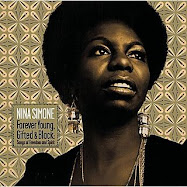
Cassandra’s music has often been compared to artists like Betty Carter, Nina Simone, and Shirley Horn, whom she also considers to be some of her musical influences. Billy Holiday and Sarah Vaugh also influenced her . Cassandra has come a long way from her high school music group and late-night singing at local clubs. Cassandra now concentrates more on the pure innovative production of her own music albums. If Cassandra Wilson’s intentions are to open people’s eyes to the broadness of her music through the messages in her songs, then she is well on her way to achieving her goal. Wilson’s emotional range and tone variations impress many critics, audiences, and fellow musicians. Many critics write that she is one of the most promising musicians on the horizon. She has received many awards due to her sensual and soulful voice. In her own hometown of Jackson, Mississippi, she was selected to receive the 1997 Governor’s Award for excellence in the Arts. Unfortunately, she was unable to accept this award due to her tour with Wynton Marsalis. Her tour, entitled Blood on the Fields, was Grammy-nominated for best vocal performance. Wilson won the “best jazz vocalist” Grammy award for her album New Moon Daughter. Her album New Moon Daughter has been described as one of her best albums, with vocals that carry sultry and contralto undertones. Cassandra’s album Blue Light Til’ Dawn was so well done that it won her the Downbeat’s “Singer of the Year” title for 1994 and 1995. In 1996, this album also won her the same honor in Down Beat’s Critic poll .She also has appeared on screen in the Arnold Schwarzenegger movie Junio. Cassandra Wilson is not overly concerned with what other people think of her or how she performs. She was named “most important and daring jazz vocalist” by Time magazine in 1996. According to one writer for the internet website “Lush Lives,” Cassandra Wilson is one of the top jazz singers of the 1990s. The writer continues, "Blessed with a distinctive and flexible voice, she is not afraid to take chances. Listeners can only wonder if Cassandra’s unique sense of singing is what attributes to her rising success. “I’m interested in crossing boundaries,” explains Wilson, “to be able to operate in several worlds at once is the result of being open-minded, whether in music or some other part of the experience. I still believe that things have to fall apart before something new can emerge. That’s true for everything, including music”
Wilson expresses herself through her music. She has become well-loved and admired because of her ability not only to sell her music but herself in the process. Senator John Horhn states that the reason Cassandra has become so successful is that she makes the music her own. “That, in turn, is why people love her so much because you feel what she is trying to tell you”. Wilson sings with the intent of getting a message to her listeners. She sings with her heart and so much of her soul that it seems as though she is literally singing to you. “ However much this life consumes me, however unbalanced things get, I always want to remember that when I look into someone else’s I am seeing myself”. There is absolutely no doubt that at the rate Cassandra is going, her contralto, sensual voice, and down-to-earth personality will draw a lot of fans for a long time to come. Since winning the Grammy award for her vocal stylings on New Moon Daughter in 1997, the call of the Delta has been beckoning her. She is currently working on a CD with 81-year-old Boogaloo Ames and his partner Eden Brent tentatively to be called Belly of the Sun. (Note: Belly of the Sun was produced but without Ames or Brent--possibly due to the death of Ames. The CD was also to include Jackson musicians Jesse Robinson on guitar, Nellie McGinnis on bass, and Rhonda Richmond on guitar).
2009 UPDATE: Cassandra Wilson won a Grammy Award for her album Loverly in 2009 as well as the 2009 Mississippi Governor's Award for Artistic Excellence in Music.
Wilson was married to Anthony Wilson from 1981 to 1983. She has a son, Jeris, born in the late 1980s. She and her son lived in Harlem, New York, for a while. In 2000, Wilson married actor Isaach de Bankolé, who directed her in the concert film Traveling Miles: Cassandra Wilson (2000).
Wilson has won several awards for her music on her album named New Moon Daughter. She was named female singer of the year in 1994 and 1995 in (DownBeat Reader’s Poll), and her album was No.1 for Best Music of 1996 (Time Magazine,1993). Ebony selected her one of America’s fifteen most beautiful black women. She has been on the cover of Essence magazine. DownBeat Magazines selected her Female vocalist of the year for 1996. Esquire named her one of the year's “Women we love” under the headlines “Diva of Desire.” A New York Times critic has called the album “One of the best albums of the decade.” Time Magazine says that she is the most accomplished jazz vocalist of her time. Her album New Moon Daughter on Blue Note Records is about different kinds of relationships and the cycles they go through. She was the first singer of her generation to win Jazz Vocalist of the year in 1993. The song “Blue Light til Dawn" examines her roots in jazz music. Her album New Moon Daughter won a Grammy award in 1997. However, Wilson's musical interests range from jazz to popular music, rhythm, and blues to folk, blues to rock.
The voice is more visual than audible; shaded, iridescent, tangible, substantial. It seems to flow effortlessly. Read any of the dozen or so biographies on Cassandra Wilson and you’ll discover some basics: born and reared in Jackson, Mississippi in the 1960s and 70s by musician and educator parents.
Classically trained on piano from age 6 until the age of 13, she also received further musical instruction as a clarinetist for the concert and marching bands of secondary school. During the 70s, she could be found performing Joni Mitchell songs behind an acoustic guitar, or singing with a blues band in Little Rock, Arkansas, in front of a large funk band in Jackson, or in the company of long-time friends in an all-girls ensemble. In the eighties, Cassandra moved to New Orleans where she performed with local luminaries Earl Turbinton and Ellis Marsalis. After a year, she relocated to East Orange, New Jersey where she made a decision to take her chances on the New York jazz scene. After a stint as the main vocalist with Steve Coleman’s M-Base Collective, Cassandra began recording on her own. Although her recording career has been somewhat erratic, Cassandra Wilson became one of the top jazz singers of the '90s, a vocalist blessed with a distinctive and flexible voice who is not afraid to take chances. She began playing piano and guitar when she was nine and was working as a vocalist by the mid-'70s, singing a wide variety of material. Following a year in New Orleans, Wilson moved to New York in 1982 and began working with Dave Holland and Abbey Lincoln. After meeting Steve Coleman, she became the main vocalist with the M-Base Collective. Although there was really no room for a singer in the overcrowded free funk ensembles, Wilson did as good a job of fitting in as was possible. She worked with New Air and recorded her first album as a leader in 1985. By her third record, a standards date, she was sounding quite a bit like Betty Carter. After a few more albums in which she mostly performed original and rather inferior material, Cassandra Wilson changed directions and performed an acoustic blues-oriented program for Blue Note called Blue Light 'Til Dawn. By going back in time, she had found herself, and Wilson has continued interpreting in fresh and creative ways vintage country blues and folk music up until the present day. During 1997 she toured as part of Wynton Marsalis' Blood on the Fields production. Traveling Miles, her tribute to Miles Davis, followed two years later. For 2002's Belly of the Sun, she drew on an array of roots musics -- blues, country, soul, rock -- to fashion a record that furthered her artistic career while still aligning well with trends in popular music. Glamoured, released in 2003, posed a different kind of challenge; half the material was composed by Wilson herself. Unwilling to stand still, Wilson gently explored sampling and other hip-hop techniques for 2006's Thunderbird. Wilson followed Loverly, another album of standards in 2008, and Silver Pony in 2010. Cassandra Wilson - Round Midnight - HQ
Cassandra Wilson - Resurrection Blues (Tutu)
Cassandra Wilson at Chicago Jazz Festival 2011 Playlist
Nancy Wilson is an American singer with more than 70 albums, and three Grammy Awards. She has been labeled a singer of blues, jazz, cabaret and pop; a "consummate actress"; and "the complete entertainer." The title she prefers, however, is song stylist. She has received many nicknames including "Sweet Nancy", "The Baby", "Fancy Miss Nancy" and "The Girl With the Honey-Coated Voice".
February 20, 1937, Nancy Wilson was the first of six children born to Olden Wilson (iron foundry worker) and Lillian Ryan (domestic worker) in Chillicothe, Ohio. Nancy's father would buy records to listen to at home. At an early age Nancy heard recordings from Billy Eckstine, Nat Cole, and Jimmy Scott with Lionel Hampton's Big Band. Nancy says: "The juke joint down on the block had a great jukebox and there I heard Dinah Washington, Ruth Brown, LaVerne Baker, Little Esther". Wilson became aware of her talent while singing in church choirs, imitating singers as a young child,and performing in her grandmother's house during summer visits. By the age of four, she knew she would eventually become a singer.
Nancy Wilson Life,Love,Joy Playlist
At the age of 15, while a student at West High School (Columbus, Ohio), she won a talent contest sponsored by local television station WTVN. The prize was an appearance on a twice-a-week television show, Skyline Melodies, which she ended up hosting. She also worked clubs on the east side and north side of Columbus, Ohio, from the age of 15 until she graduated from West High School, at age 17.
Unsure of her future as an entertainer, she entered college to pursue teaching. She spent one year at Ohio's Central State College (now Central State University) before dropping out and following her original ambitions. She auditioned and won a spot with Rusty Bryant's Carolyn Club Big Band in 1956. She toured with them throughout Canada and the Midwest in 1956 to 1958. While in this group, Nancy made her first recording under Dots Records.
[From Wikipedia]
Nancy Wilson - Jazz Scene USA 1962 - Complete Show
Miss Nancy Wilson: The Very Thought Of You - 1964
When Nancy met Julian "Cannonball" Adderley, he suggested that she should move to New York City, believing that the big city would be the venue in which her career could bloom. In 1959, she relocated to New York with a goal of obtaining Cannonball’s manager John Levy as her manager and Capitol Records as her label. Within four weeks of her arrival in New York she got her first big break, a call to fill in for Irene Reid at "The Blue Morocco". The club booked Wilson on a permanent basis; she was singing four nights a week and working as a secretary for the New York Institute of Technology during the day. John Levy sent demos "Guess Who I Saw Today", "Sometimes I’m Happy", and two other songs to Capitol. Capitol Records signed her in 1960.
Nancy’s debut single, "Guess Who I Saw Today", was so successful that between April 1960 and July 1962 Capitol Records released five Nancy Wilson albums. Her first album, Like in Love, displayed her talent in Rhythm and Blues, with the hit R&B song "Save Your Love for Me." Adderley suggested that she should steer away from her original pop style and gear her music toward jazz and ballads. In 1962, they collaborated, producing the album Nancy Wilson and Cannonball Adderley, which propelled her to national prominence, and Wilson would later appear on Adderley's live album In Person (1968). Between March 1964 and June 1965, four of Wilson's albums hit the Top 10 on Billboard's Top LPs chart. In 1963 "Tell Me The Truth" became her first truly major hit, leading up to her performance at the Coconut Grove in 1964 – the turning point of her career, garnering critical acclaim from coast to coast. TIME said of her, "She is, all at once, both cool and sweet, both singer and storyteller." In 1964 Nancy released what became her most successful hit on the Billboard Hot 100 with "(You Don't Know) How Glad I Am", which peaked at No. 11. From 1963 to 1971 Wilson logged eleven songs on the Hot 100, including two Christmas singles. However, "Face It Girl, It's Over" was the only remaining non-Christmas song to crack the Top 40 for Wilson (#29, in 1968)
[From Wikipedia]
NANCY WILSON -(YOU DON'T KNOW) HOW GLAD IAM
Nancy Wilson, The Emotions - Don't Ask My Neighbors
NANCY WILSON LIVE - GUESS WHO I SAW TODAY
After making numerous television guest appearances, Wilson eventually got her own series on NBC, The Nancy Wilson Show (1967–1968), which won an Emmy in 1975. Over the years she has appeared on many popular television shows from I Spy (more or less playing herself as a Las Vegas singer in the 1966 episode "Lori," and a similar character in the 1973 episode "The Confession" of The F.B.I. ), Room 222, Hawaii Five-O, Police Story, The Jack Paar Program, The Sammy Davis, Jr. Show (1966), The Danny Kaye Show, The Smothers Brothers Comedy Hour, Kraft Music Hall, The Sinbad Show, The Cosby Show, The Andy Williams Show, The Carol Burnett Show, Soul Food, New York Undercover, and recently Moesha, and The Parkers. She also appeared on The Ed Sullivan Show, The Merv Griffith Show, The Tonight Show, The Arsenio Hall Show and The Flip Wilson Show. She was in the 1993 Robert Townsend's The Meteor Man and in the film, The Big Score. She also appeared on The Lou Rawls Parade of Stars and the March of Dime Telethon. She was signed by Capitol records in the late 1970s and in an attempt to broaden her appeal she cut the album Life, Love and Harmony, an album of soulful, funky dance cuts that included the track "Sunshine", which was to become one of her most sought-after recordings (albeit among supporters of the rare soul scene with whom she would not usually register).
[From Wikipedia]
Nancy Wilson (Someone to Watch Over Me)
Satin Doll / Count Basie Orchestra Live in Tokyo 1985
Wilson married her first husband, drummer Kenny Dennis, in 1960. In 1963, their son, Kenneth (Kacy) Dennis, Jr., was born, and by 1970, they divorced. On May 22, 1973, she married a Presbyterian minister, the Reverend Wiley Burton. She gave birth to Samantha Burton in 1975, and the couple adopted Sheryl Burton in 1976. As a result of her marriage, she abstained from performing in various venues, such as supper clubs. In this decade, she focused on her family, relocating to Pioneertown, California, to raise her children in a rural setting.
For the following two decades, she successfully juggled her personal life and her career. In November 1998, both of her parents died: she calls this year the most difficult of her life. In August 2006, Wilson was hospitalized with anemia and potassium deficiency, and was on I.V. sustenance while undergoing a complete battery of tests. She was unable to attend the UNCF Evening of Stars Tribute to Aretha Franklin and had to cancel an engagement. All of her other engagements were on hold, pending doctors’ reports for that month. In March 2008, she was hospitalized for lung complications, recovered and claimed to be doing well. In the same year, her husband, Wiley Burton, died after suffering from renal cancer.
Nancy Wilson- "Forbidden Lover"
NANCY WILSON LIVE - I CAN'T MAKE YOU LOVE ME
Nancy Wilson - You Got the Move
Nancy Wilson - Welcome To My Love - Full 1967 vinyl album
Nancy Wilson - Full Concert - 08/15/87 - Newport Jazz Festival
In a distinguished musical career spanning six decades, Peterson recorded over 200 albums, won eight Grammy Awards, received 16 doctorates from American and Canadian universities, including York University where he served as chancellor and was promoted to Companion of the Order of Canada in 1984 after being made an Officer 12 years earlier. Performer/composer Oscar Peterson, who Duke Ellington once referred to as the Maharajah of the keyboard,was among the celebrated Canadians who were inducted into the national Walk of Fame. Oscar Peterson Remembered Playlist
Oscar Emmanuel Peterson was born August 15, 1925 in Montreal, Quebec, Canada. His parents were immigrants from the British West Indies and Virgin Islands. His father, Daniel Peterson, was boatswain on a merchant ship when he met Olivia John in Montreal, where she worked as a cook and housekeeper for an English family. Daniel gave up the sailing work and began working as a porter for the Canadian Pacific Railway. He and Olivia married and stayed in Montreal as their family grew.
Oscar was the fourth of five children. Their father insisted that they all learn a musical instrument, and Oscar began to study the trumpet. A childhood bout of tuberculosis forced a fortuitous switch to the piano, under the tutelage of his father and his older sister, Daisy. It soon became apparent that Oscar’s talent surpassed the capabilities of home teaching, and he was sent first to teacher Lou Hooper and then to the gifted Hungarian classical pianist, Paul deMarky. A warm and respectful musical friendship developed between the two, and with Mr. deMarky’s guidance Oscar’s mastery of the instrument grew, along with his dedication to and command of his talent.
The performance career of Oscar Peterson began while he was still a young teenager in high school, as pianist with the Johnny Holmes Orchestra in Montreal. After a few years with the Orchestra, he formed his own trio, the first in a format he maintained throughout his lifelong career. With the trio, he quickly gained fame and popularity throughout Canada. His appearances at the Alberta Lounge in Montreal were broadcast live on the radio. In 1949 impresario Norman Granz heard one of those broadcasts, went to the Alberta Lounge and enticed Mr. Peterson into making a surprise guest appearance with Granz’ all-star “Jazz at the Philharmonic” at Carnegie Hall later that year. Leaving the audience awestruck, Oscar joined JATP in 1950 as a full-time touring member. He formed a piano-bass duo with Ray Brown as well, and began recording for Granz at the same time. He also added Barney Kessel as the first of the guitarists with whom he would create trios, returning to the group format he loved.
He was voted Jazz Pianist of the Year in 1950 by the Downbeat Readers’ Poll, a title he garnered for an additional twelve years. He toured the globe extensively with Jazz at the Philharmonic as well as with his own trio. Oscar Peterson - Live In'63,'64 &'65
During the busy touring years in the early 1960s he founded a jazz school in Toronto called the Advanced School of Contemporary Music. This attracted students from all over the world. For a few months each year he and his trio, along with Phil Nimmons, a clarinetist from Toronto, would conduct classes at the school. The demands of his touring schedule forced closure of the school after a few years, but students still fondly recall their experiences there.
Oscar Peterson began composing while still a member of the Johnny Holmes Orchestra, and as time progressed he devoted more and more time to composition, while still maintaining a vigorous performance schedule. His “Hymn To Freedom” became one of the crusade songs of the Civil Rights Movement led by Dr. Martin Luther King, Jr. in the United States. It is still performed frequently by choirs worldwide. He also composed a salute to his beloved Canada, “The Canadiana Suite,” in the early 1960s. He has composed music for motion pictures, including the Canadian film “Big North,” made for Ontario Place in Toronto, and the feature film “The Silent Partner,” for which he won the Genie Award (Canadian Oscar award) for best original film score in 1978. He composed work for the National Film Board of Canada. His collaboration with filmmaker Norman McLaren on the film “Begone Dull Care” won awards all over the world. He composed the soundtrack for the film “Fields of Endless Day,” about U.S. slaves using the Underground Railroad to escape to Canada. Other compositional projects include a jazz ballet, a suite called “Africa,” and the Easter Suite, commissioned by the BBC in London and broadcast live on Good Friday in 1984, with annual broadcasts after that. “A Salute to Bach” for the composer’s 300th birthday, premiered with trio and orchestra at Toronto’s Roy Thomson Hall in 1985. He composed a suite for the Olympic Arts Festival of the Calgary Winter Olympics in 1988, and music for the opening ceremony of the Skydome in Toronto. In addition, Oscar Peterson composed more than 400 other pieces, many of which he performed and others continue to perform. Some of these compositions remain unpublished, but hopefully they will be published for future generations to hear.
Oscar Peterson has an extensive discography of his trio and quartet recordings, as well as his recordings with many of the other jazz greats. His varied albums include recordings with Ella Fitzgerald, Count Basie, Louis Armstrong, Duke Ellington, Dizzy Gillespie, Roy Eldridge, Ben Webster, Coleman Hawkins and Joe Pass. His worldwide performances and his recordings, particularly those with his trios and quartets, brought him recognition from numerous places all around the world.
Mr. Peterson also made many television appearances during his lifetime. He hosted five different talk show series, and Oscar’s widespread appeal led to his interviewing a variety of guests. The unusual range of personalities to appear on these programs included the former Prime Minister of England, the Rt. Hon. Sir Edward Heath, Twiggy, Anthony Burgess as well as many musicians. He also appeared in television commercials “Tears Are Not Enough,” a musical fundraiser for African famine relief.
Preferring not to use his celebrity status to sway public opinions, Mr. Peterson nevertheless remained dedicated to the belief that his native Canada has a responsibility in leading the world in equality and justice. With this in mind, he took a firm stand to promote the cause of human rights fair treatment for Canada’s multicultural community. In recognition of this effort, Mr. Peterson was promoted to Companion of the Order of Canada, Canada’s highest civilian honor. He had been inducted as an Officer of the Order in 1972.
During his life and career Mr. Peterson received many awards and honors. These include the Praemium Imperiale (the Arts equivalent of the Nobel Prize, presented by the Japan Art Association), the UNESCO International Music Prize, 8 Grammy Awards (including a Lifetime Achievement Grammy), the 1993 Glenn Gould Prize, of which he was the third recipient, the first chosen by unanimous decision and the first ever non-classical musician, and many honorary degrees.
Despite a stroke in 1993 that debilitated his left hand, Oscar Peterson was determined to continue performing, recording and composing. Within a year he had recovered and resumed his worldwide concert appearance schedule.
Oscar Peterson lived in the quiet city of Mississauga, Ontario, Canada. His hobbies included fishing, photography and astronomy. He was an avid audiophile and synthesist, as music was not only his profession but also his hobby. His home contained his own private recording studio, allowing him to work and still enjoy his family life. His passion for life, love and music remained strong for his entire life, and he continued to perform until shortly before his death. Oscar Peterson passed away at his home on the morning of December 23, 2007. His legacy lives on through his music. Oscar Peterson and Count Basie Live 1974
National Campaign for Justice
-
National Campaign for Justice
Lorenzo Salgado Araujo shot and killed by ICE agent in Houston, authorities
confirm:
Tell Harris Count...


.jpg)




 Posts
Posts