Thursday, January 12, 2012
Grover Washington Jr.
Grover Washington Jr. - Winelight
Grover Washington Jr. - Mister Magic
Grover Washington, Jr.'s love of music began as a child, Grover was born in Buffalo, New York on December 12, 1943. His mother was a church chorister, and his father was a collector of old Jazz gramophone records and a saxophonist as well, so music was everywhere in the home. He grew up with the great jazzmen and big band leaders like Benny Goodman, Fletcher Henderson, and others like them. At the age of 8, Grover Sr. gave Jr. a saxophone. After I started playing," Grover says, "I'd sneak into clubs to watch guys like Jack McDuff, Harold Vick and Charles Lloyd. My professional life began at age twelve. I played a lot of R&B, blues, and what we used to call 'gut-bucket'."
Washington left Buffalo and played with a Midwest group called the Four Clefs and then the Mark III Trio from Mansfield, Ohio. He was drafted into the U.S. Army shortly thereafter, which was to his advantage, as he met drummer Billy Cobham. A music mainstay in New York City, Cobham introduced Washington to many New York musicians. After leaving the Army, Washington freelanced his talents around New York City, eventually landing in Philadelphia in 1967. Grover also met his wife Christine (who acted as his business partner as well) in Philadelphia around that time; they married shortly after his discharge in 1967. The two were happily married till death; their son, Grover III (who co-produced a Grammy-nominated song on Grover's last album) now lives in Los Angeles and their daughter, Shana attended Temple University. In 1970 and 1971, he appeared on Leon Spencer's first two albums on Prestige Records, together with Idris Muhammad and Melvin Sparks.
Washington's big break came at the expense of another artist. Alto sax man Hank Crawford was unable to make a recording date with Creed Taylor's Kudu Records, and Washington took his place, even though he was a backup. This led to his first solo album, Inner City Blues. He was talented and displayed heart and soul with soprano, alto, tenor, and baritone saxophones. Refreshing for his time, he made headway into the jazz mainstream.
Whilst his first three albums established him as a force in jazz and soul music, it was his fourth album in 1974, Mister Magic, that proved a major commercial success. The album climbed to number 10 in Billboard's Top 40 album chart and the title track reached #16 on the R&B singles chart (#54, pop). All these albums included guitarist Eric Gale as a near-permanent member in Washington's arsenal. His follow-up on Kudu in 1975, Feels So Good also made #10 on the album chart.
A string of acclaimed records brought Washington through the 1970s, culminating in the signature piece for everything he would do from then on. Winelight (1980) was the album that defined everything Washington was then about, having signed for Elektra Records, part of the major Warner Music group. The album was smooth, fused with R&B and easy listening feel. Washington's love of basketball, especially the Philadelphia 76ers, led him to dedicate the second track, "Let It Flow", to Julius Erving (Dr. J). The highlight of the album was his collaboration with soul artist Bill Withers, "Just the Two of Us," a huge hit on radio during the spring and summer of 1981, peaking at #2 on the Hot 100. The album went platinum in 1981, and also won Grammy Awards in 1982 for Best R&B Song ("Just The Two of Us"), and Best Jazz Fusion Performance ("Winelight"). "Winelight" was also nominated for Record of the Year and Song of the Year.
In the post-Winelight era, Washington is credited for giving rise to a new batch of talent that would make its mark in the late 1980s and early 1990s. He is known for bringing Kenny G to the forefront as well as such smooth jazz artists as Walter Beasley, Steve Cole, Pamela Williams, Najee, and George Howard. His song Mr. Magic is noted as being influential on Go-go music starting in the mid-1970s.
Reflecting on his life, Grover says, "I'm thankful for the people who inspired me over the years: Dexter Gordon, Rahsaan Roland Kirk, Stanley Turrentine, Cannonball Adderley, Sonny Rollins, Oliver Nelson. I would like to believe that some of the reason I've been around so long is that I don't do the same thing over and over--I like to grow, to keep adding another thread to my musical tapestry," he adds. "I'm just staying true to the things that got me to play in the first place."
On December 17, 1999, while waiting in the green room after taping four songs for The Saturday Early Show, at CBS Studios in New York City, Washington collapsed. He was taken to St. Luke's-Roosevelt Hospital, where he was pronounced dead at about 7:30 p.m. He was 56 years old. His doctors determined that he had suffered a massive heart attack.
Grover Washington Jr. - Just the two of us (1981) HD and HQ
Grover Washington Jr. - Let It Flow (for ''Dr. J.'')
Grover Washington Jr. - Make Me A Memory (Sad Samba)
Grover Washington Jr - Sausalito
Grover Washington Jr with Kenny Burrell - Summertime
Grover Washington Jr - Can You Stop The Rain
Grover Washington Jr. - "Ain't No Sunshine"
Sunday, December 25, 2011
Jazz For Christmas
Ramsey Lewis Trio - Merry Christmas Baby (1961)
John Coltrane - What Child Is This? (Greensleeves) Live @ Village Vanguard (1961)
Oscar Peterson plays Jingle Bells
Bill Evans / Santa Claus Is Coming To Town
Charlie Parker-White Christmas
Louis Armstrong / Christmas in New Orleans & Billie Holiday / I've Got My Love To Keep Me Warm
Miles Davis - blue xmas
Wynton Christmas
Silent Night - Kathleen Battle, Wynton Marsalis
The Christmas Song - Dexter Gordon Quartet
Kenny Burrell - Have Yourself A Merry Christmas.WMV
Jimmy Smith God Rest Ye Merry, Gentlemen
Dave Koz & Friends - Smooth Jazz Christmas Overture
Ramsey Lewis Trio - God Rest Ye Merry, Gentlemen (1961)
Oscar Peterson plays O Christmas Tree
Thursday, December 22, 2011
Wednesday, October 26, 2011
John Coltrane Tribute to the greatest Tenor saxophonist of all time, John William Coltrane (Trane)
Merely mention the name John Coltrane and you’re likely to evoke a deeply emotional, often spiritual response from even the most casual jazz fan. John Coltrane was the most revolutionary and widely imitated saxophonist in jazz.
Born September 23, 1926 in Hamlet, North Carolina, John Coltrane was always surrounded by music.Coltrane grew up in High Point, North Carolina, his father played several instruments sparking Coltrane’s study of E-flat horn and clarinet. While in high school, (at about the age of 15) Coltrane’s musical influences shifted to the likes of Lester Young and Johnny Hodges prompting him to switch to alto saxophone. After moving to Philadelphia, he continued his musical training at Granoff Studios and the Ornstein School of Music. He was called to military service during WWII, where he performed in the U.S. Navy Band (1945-46) .
After the war,he played alto saxophone in the bands led by Joe Webb and King Kolax, then changed to the tenor to work with Eddie "Cleanhead" Vinson (1947-48). He performed on either instrument as circumstances demanded while in groups led by Jimmy Heath, Howard McGhee, Dizzy Gillespie (with whom he made his first recording in 1949), Earl Bostic, and lesser-known rhythm-and-blues musicians, but by the time of his membership in Johnny Hodges's septet (1953-54) he was firmly committed to the tenor instrument. Coltrane began playing tenor saxophone with the Eddie "CleanHead" Vinson Band, and was later quoted as saying, "A wider area of listening opened up for me. There were many things that people like Hawk, and Ben and Tab Smith were doing in the ‘40’s that I didn’t understand, but that I felt emotionally." Prior to joining the Dizzy Gillespie band, Coltrane performed with Jimmy Heath where his passion for experimentation began to take shape. However, it was his work with the Miles Davis Quintet with Red Garland, Paul Chambers, and Philly Joe Jones (1955-57) that would lead to his own musical evolution. " Miles music gave me plenty of freedom," he once said. During that period, he became known for using the three-on-one chord approach, and what has been called the ‘sheets of sound,’ a method of playing multiple notes at one time.
Coltrane next played in Thelonious Monk's quartet (July-December 1957), but owing to contractual conflicts took part in only one early recording session of this legendary group. He rejoined Davis and worked in various quintets and sextets with Cannonball Adderley, Bill Evans, Chambers, Jones, and others (1958-60). While with Davis he discovered the soprano saxophone, purchasing his own instrument in February 1960. Throughout the 1950s addiction to drugs and then alcoholism disrupted his career. Shortly after leaving Davis, however, he overcame these problems.

Having led numerous studio sessions, established a reputation as a composer, and emerged as the leading tenor saxophonist in jazz, Coltrane was now prepared to form his own group; it made its debut at New York's Jazz Gallery in early May 1960. After briefly trying Steve Kuhn, Pete La Roca, and Billy Higgins, Coltrane hired two musicians who became longstanding members of his quartet, McCoy Tyner (1960-65) and Elvin Jones (1960-66); the third, Jimmy Garrison, joined in 1961. With these sidemen the quartet soon acquired an international following. At times Art Davis added a second double bass to the group; Eric Dolphy also served as an intermittent fifth member on bass clarinet, alto saxophone, and flute from 1961 to 1963,eventually adding players like Pharoah Sanders. The John Coltrane Quartet created some of the most innovative and expressive music in Jazz history including the hit albums: "My Favorite Things," "Africa Brass," " Impressions," " Giant Steps," and his monumental work "A Love Supreme" which attests to the power, glory, love, and greatness of God. Coltrane felt we must all make a conscious effort to effect positive change in the world, and that his music was an instrument to create positive thought patterns in the minds of people.Coltrane turned to increasingly radical musical styles in the mid-1960s. These controversial experiments attracted large audiences, and by 1965 he was surprisingly affluent. From autumn 1965 his search for new sounds resulted in frequent changes of personnel in his group. New members included Pharoah Sanders, Alice Coltrane (his wife), Rashied Ali (a second drummer until Jones' departure), several drummers as seconds to Ali, and a number of African-influenced percussionists. In his final years and after his death, Coltrane acquired an almost saintly reputation among listeners and fellow musicians for his energetic and selfless support of young avant-garde performers, his passionate religious convictions, his peaceful demeanor, and his obsessive striving for a musical ideal.
In 1967, liver disease took Coltrane’s life leaving many to wonder what might have been. Yet decades after his departure his music can be heard in motion pictures, on television and radio. Recent film projects that have made references to Coltrane’s artistry in dialogue or musical compositions include, "Mr. Holland’s Opus", "The General’s Daughter", "Malcolm X", "Mo Better Blues", "Jerry McGuire", "White Night", "The Last Graduation", "Come Unto Thee", "Eyes On The Prize II" and "Four Little Girls". Also, popular television series such as "NYPD Blue", "The Cosby Show", "Day’s Of Our Lives", "Crime Stories" and "ER", have also relied on the beautiful melodies of this distinguished saxophonist.
In 1972, "A Love Supreme" was certified gold by the RIAA for exceeding 500,000 units in Japan. This jazz classic and the classic album "My Favorite Things" were certified gold in the United States in 2001.In 1982, the RIAA posthumously awarded John Coltrane a Grammy Award of " Best Jazz Solo Performance" for the work on his album, "Bye Bye Blackbird". In 1997 he received the organizations highest honor, the Lifetime Achievement Award.On June 18, 1993 Mrs. Alice Coltrane received an invitation to The White House from former President and Mrs. Clinton, in appreciation of John Coltrane’s historical appearance at the Newport Jazz Festival.
In 1995, John Coltrane was honored by the United States Postal Service with a commemorative postage stamp. Issued as part of the musicians and composers series, this collectors item remains in circulation.
John Coltrane & Miles Davis - Bye Bye Blackbird
My Favorite Things - John Coltrane
John Coltrane live, 1965, playing "Naima".
John Coltrane - Dear Lord
John Coltrane - Spiritual
John Coltrane - Afro Blue
After the rain - John Coltrane
John Coltrane "Stardust" (1958)
John Coltrane - Lover, Come Back to Me
JOHN COLTRANE: A Love Supreme I - II - III - IV (33:04 full version) - HQ Audio
John Coltrane & Miles Davis - Bye Bye Blackbird
My Favorite Things - John Coltrane
John Coltrane live, 1965, playing "Naima".
John Coltrane - Dear Lord
John Coltrane - Spiritual
John Coltrane - Afro Blue
After the rain - John Coltrane
John Coltrane "Stardust" (1958)
John Coltrane - Lover, Come Back to Me
JOHN COLTRANE: A Love Supreme I - II - III - IV (33:04 full version) - HQ Audio
Saturday, May 14, 2011
John Coltrane - JAZZ
John Coltrane - Blue Train
John Coltrane - Moment's Notice
John Coltrane - Equinox (Original)
John Coltrane - Feeling Good
John Coltrane - I'm Old Fashioned
John Coltrane - You Don't Know What Love Is
John Coltrane - Love , First Meditations, 1965
Sunday, December 5, 2010
Friday, October 30, 2009
O'DONEL Levy, Jeremy Monteiro, Eldee Young LIVE @ Montreux 1988
O’Donel Levy has performed at some of the biggest festivals with some of the biggest audiences in the world. He was the main attraction at the Montreux Festival. He’s played with the who’s who of blues, jazz, and even soul. He has appeared with the late great Miles Davis. He has stood beside Dizzy Gillespie, Wynton Marsalis, Jimmy McGriff, Jack McDuff, and that’s just the beginning. If he hasn’t played with them, he has written music for them. He’s written music for Luther Vandross, Sarah Vaughn, and his friend, Herbie Mann.
O’Donel Levy

Baltimore CITYPAPER
By Geoffrey Himes
O'Donel Levy remembers sitting on a stoop in the Gilmor Homes, the West Baltimore housing project, in the early '50s, watching his neighbor Ethel Ennis going off to one of her jazz gigs dressed in a glittery gown. It was proof positive that someone from Gilmor could have a career in music. He decided that's what he wanted.
That's what he got. He developed into one of the world's top soul-jazz guitarists, touring and recording with the likes of Herbie Mann, Jimmy McGriff, Richard "Groove" Holmes, and Ennis herself. Levy released six of his own albums on Sonny Lester's Groove Merchant Records in the '70s, and he led his own band at Switzerland's Montreux Jazz Festival for years.
Since a 2006 stroke, however, he has been confined to a wheelchair, his paralyzed left side unable to fret a guitar. He resides at the Summit Park Health and Rehabilitation Center in Catonsville, working hard on his agonizingly slow and uncertain recovery. To help pay for all these medical bills, many top jazz musicians--from Baltimore and far beyond--are staging benefit concerts for Levy at Sojourner-Douglass College this Sunday, Oct. 4. Despite his problems, though, the 64-year-old musician, "Butch" to his Baltimore buddies, remains irrepressibly upbeat. In the course of a long interview, he teases his wife and cracks jokes about food as if he were back on stage. He's not just a jazz musician, he insists; he's an entertainer.
"I'm not a blues player or a jazz player," he explains. "I'm more a combination. My father and his brother Roy used to sit around the living room and play those guitars when I was growing up. They would do those old foot-stomping blues like 'Caldonia, Caldonia, what makes your big head so hard?' I wanted to grab that guitar and play, too. When I was four or five, I would look at them and say, 'Boy I'm going to do that when I grow up.'"
He was gigging by the time he was 16, first with local saxophonist Boyd Anderson and then in a quartet with his pals from the Gilmor Homes: drummer Chester Thompson (who went on to play with Weather Report, the Pointer Sisters, and Genesis), organist Charles Covington, and vocalist Judd Watkins. They were basically an organ trio plus a singer, and because organ trios ruled the Baltimore music scene in the early '60s, the quartet thrived.
"I loved that B-3 sound," Levy recalls. "I grew up with it and it got in my ear. The organist has to tap out the bass line on those foot pedals, while the left hand runs chords and the right hand does the tune--confusing stuff but Charles was a genius at it. For a jazz guitarist, that's the best because there's room to shine. I knew George Benson when he was playing with Jack McDuff's organ trio at Paul's Mall in Boston. George asked if I would take his place because he was leaving to record with Creed Taylor."
The McDuff gig got Levy out of his hometown, and soon he was hired by one organist after another: McGriff, Holmes, and Charlie Earland. Levy was in demand because his muscular chording could hold down the rhythm when the organist was soloing, and Levy's melodic solos could hold a room's attention when it was his turn to take over.
Levy was leading his own quartet at the Pigfoot, Washington's jazz-guitar showcase, when this writer reviewed him in 1980. Levy sported a healthy afro and thick glasses and rested a hollow-body Gibson electric in his lap. He played fast, but his articulation was so crisp that the notes never blurred together; each one carried its individual sting. Amid the swarm of notes, the listener could always pick out the original melody of the song, whether it was a pop-soul hit like Bobby Hebb's "Sunny" or a jazz standard like Miles Davis' "So What."
That same year Herbie Mann auditioned Levy's trio at Blues Alley in Washington. The famous flutist was so impressed with Levy's playing and band leading that Mann hired the group for an upcoming tour. He was so taken with the guitarist's writing that four of the eight tracks on Mann's 1985 album for Atlantic, See Through Spirits, were Levy's compositions. The guest saxophonist on that session, David "Fathead" Newman, remembered Levy's writing and re-recorded "Keep the Spirits Singing" as the title track of his 2001 album.
"It's a vocalese number with a South American feel to it," Ethel Ennis says. "I love lines that are repeated because you want to hear them again, and that song has that. He always created good running lines, happy phrases--his fingers would just be flying. I'd always wanted to record that particular song with him, but I never got around to it before the stroke. So it is a loss."
When Mann's group toured the Far East, Levy was such a hit in Singapore that he was invited to return with his own group. That went over so well that a government official arranged a studio job and regular nightclub gig in the island city. The son of the Gilmor Homes moved to Singapore in 1989 and didn't return home for 10 years. When he did, he set up his own studio in Bel Air and was producing several album projects when he suffered a stroke on Oct. 20, 2006.
"Michael Matthews, a bass player, went by the studio," recounts the guitarist's wife Estella Ingram-Levy. "He saw Butch's car but he couldn't get in. So he got somebody to break down the door. He found Butch on the floor of the bathroom and Butch muttered, 'Call 911.'
"The stroke was massive, I'm telling you--they had to take part of his skull off to relieve the pressure on the brain. The physician didn't give him much hope, but he pulled through it. His left hand and his left leg now have feeling, but he still can't walk by himself. But he's in great spirits and he's optimistic."
This reporter first heard Levy when he was backing up Ennis at Annapolis' King of France Tavern in 1979. The guitarist had just come back from Los Angeles for the shows, which were being recorded for an album that was eventually released as Ethel. The highlight of the show--and the record--was an extended version of "Open Your Eyes You Can Fly," written by Chick Corea as a vehicle for Flora Purim. Ennis' version opened with Bob Wyatt clattering his percussion like a distant thunderstorm. Ennis held each high, trembling note as if in a house rattled by Levy's stormy chording. This led to a crackling duet between Levy's guitar and Covington's synthesizer. Finally Levy's solo broke into the open, a grand leap of invention that extended the melody beyond its usual boundaries.
"That comes from doing a lot of listening," Levy says today. "You have to mimic those Coltrane and Miles lines before you come up with your own. I used to buy Chick Corea's stuff and sit down and learn those lines. You never know what you're going to get into. When somebody says, 'Solo,' you've got to be ready to go."
O'Donel Levy - Playhouse
O'Donel Levy
O'Donel Levy
O'Donel Levy - Call Me
O'Donel Levy "Never Can Say Goodbye"
1973 album, "Breeding Of Mind"
Saturday, June 20, 2009
Sunday, June 14, 2009
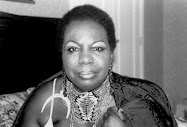
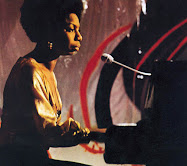
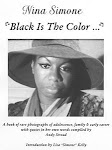
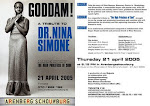
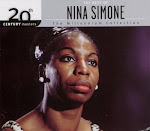
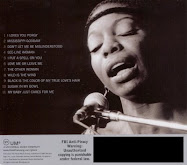
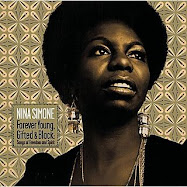
Nina Simone: She Cast a Spell and Made a Choice
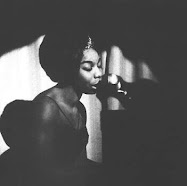
When Nina Simone died quietly in her home in southern France on 21 April 2003, the spiritual essence of three generations of freedom fighters passed on to the otherworld the proverbial crossroads with her. With a voice that embodied the pain and power of the scattered African Diaspora and classic West African facial features that suggested a short distance between the Tyron, North Carolina of her birth and Ghana.
She was the voice of a movement. Deep blues, even darker hues, from the Delta to Dakar. When the old guard of the Civil Rights Movement talked about the “voice” of the movement, they always invoked Nina Simone, Ms. Simone to all those who couldn't wrap their minds around this woman, Black woman, protest woman, iconic woman, the one woman whose very voice summoned the spirits of the Middle Passage, of those under the overseer's lash, of that charred fruit hanging from southern trees, the sprits of blues whisperers, sacred singers, heavenly shouters and insatiable desires. This woman, Black woman, was the voice of a people.
In the early 1960s, Simone's music began to more directly echo the tenor of the times. Once the darling of the supper club set, Simone was more likely to be found performing at a Civil Rights fundraiser. It was because of her experiences with the movement that Simone wrote and recorded her most potent critique of American racism, “Mississippi Goddamn” She was dramatically moved by the bombing of the 16th Street Baptist Church in Birmingham, Alabama, which killed four little Black girls. Simone restrained her own rage and transformed it into the scathing political anthem, “Mississippi Goddamn”. The song was recorded live at Carnegie Hall in March of 1964. Simone's career and her access to the supper club set would be radically altered by the recording. The brilliance of the song lies in the way she initially destabilized the immediate reception of the song, by placing the song's lyrics on top of a swinging show tune beat as she speak truth to power.
“Alabama's got me so upset / Tennessee makes me lose my rest /
And everybody knows about Mississippi, Goddamn /
Don't tell me, I tell you /
Me and my people just about due /
I've been there so I know /
You keep on saying go slow”
Click Here For The Rest Of The Story
Thursday, June 11, 2009
Nina Simone - I Got It Bad
Nina Simone - If You Knew
If you knew how I missed you
You would not stay away today
Don't you know I need you
Stay here my dear with me
I need you here my darling
Together for a day a day
Together never parting
Just you just me my love
I can't go on without you
Your love is all I'm living for
I love all things about you
Your heart your soul my love
I need you here beside me
Forever and a day a day
I know whatever betides me
I love you I love you I do
Nina Simone - If You Knew
If you knew how I missed you
You would not stay away today
Don't you know I need you
Stay here my dear with me
I need you here my darling
Together for a day a day
Together never parting
Just you just me my love
I can't go on without you
Your love is all I'm living for
I love all things about you
Your heart your soul my love
I need you here beside me
Forever and a day a day
I know whatever betides me
I love you I love you I do
Jimmy Smith
Jimmy Smith Born in Norristown outside of Philadelphia on December 8, 1928. Both of his parents were pianists, Jimmy revealed his musical talents early. He was playing stride piano by fourteen and performing with his piano-playing father in a dance team during the early forties. A prodigy who won a Major Bowes contest in 1935, Smith quickly gained experience working throughout western Pennsylvania, performing on the radio in Philadelphia, and teaming with his dad for nightclub work. Jimmy sings as he speaks of his father. "My ol' man played the Old Town stuff. He was a D-flat piano player. He played a bass and the chord, yeah. He was working when I wasn't working. Oh man, Daddy was working four nights a week--I mean making good bucks plus plastering in the day time."
Click Here for the rest of the story
Jimmy Smith (Jazz Organ)
Jimmy Smith Music
Jimmy Smith - Organ - Playlist
JIMMY SMITH'' 'MOANIN'
Jimmy Smith - Honky Tonk
Jimmy Smith - Midnight Special - 1985
A Night in Tunisia Jimmy Smith Quintet
Subscribe to:
Posts (Atom)